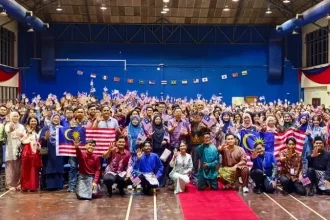

LABUAN — A total of 50 participants attended the 2026 Qibla and Hilal Observation Training of Trainers (TOT) Programme aimed at strengthening their knowledge, skills and competencies in Islamic astronomy, particularly in determining the qibla direction and observing the new moon.
The two-day programme was held at the Layangan Meeting Room on Level 11 of the Universiti Malaysia Sabah Labuan International Campus (UMSKAL) Tower Building.
Participants comprised UMSKAL lecturers, staff and students, as well as officers from the Labuan Federal Territory Islamic Religious Department (JAWI) and the Federal Territories Islamic Religious Council (MAIWP).
Representatives from the Labuan Youth Association (PAMULA) and accredited Islamic religious teachers in the Federal Territory of Labuan also participated.
The programme was organised by the Labuan Federal Territory Mufti Department in collaboration with UMSKAL and the Negeri Sembilan Mufti Department.
It was conducted by Negeri Sembilan Mufti Department Assistant Mufti for the Falak Division Ustaz Agku Bolkhizan A. Ahmad Thani and Assistant Islamic Affairs Officer for the Falak Unit Ustaz Nor Hafiz Abu Kassim.
Participants also took part in a practical session at the new moon observation centre on Level 13 of the UMSKAL Tower Building.
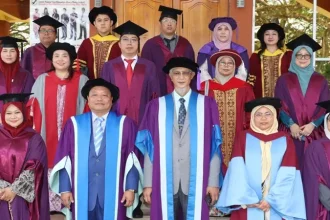
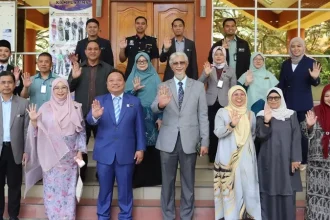
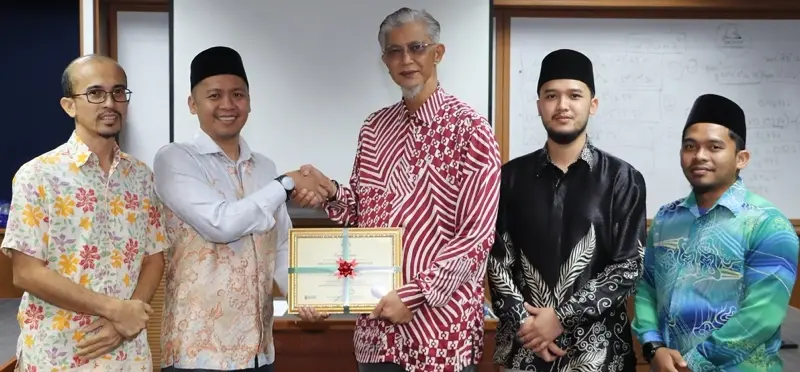
The closing ceremony was officiated by UMSKAL director Prof Dr Shamsul Bahari Shamsudin last Thursday.
Also present were Labuan Mufti Department Falak Unit Islamic Affairs Officer Ustaz Mohd Omar Sullahaji and UMSKAL Islamic Affairs and Mosque Sector head Ustaz Alfaiz Darsono, who is also the campus’ Islamic Affairs Officer.
Islamic astronomy, commonly known as ilmu falak, is the study of the movement of celestial bodies, particularly the moon, sun, stars and planets along their respective orbits.
The term falak appears twice in the Quran, namely in verse 40 of Surah Yasin and verse 33 of Surah Al-Anbiya.
Today, the field is more widely known as astronomy, with a broad scope covering the universe and celestial phenomena.
In Malaysia, the application of falak syarie by state mufti departments, with support from the Department of Survey and Mapping Malaysia (JUPEM), focuses primarily on matters related to Islamic religious observance.
These include determining prayer times and the qibla direction, preparing the Hijri calendar, sighting the new moon and observing solar and lunar eclipses.
Technological advancements have also transformed astronomical activities from the use of traditional instruments such as armillary spheres, astrolabes, quadrants and sundials to modern equipment, including telescopes and total stations.
Such equipment is increasingly used by JUPEM and agencies involved in new moon observation and other astronomy-related activities.
As one of the oldest fields of knowledge, Islamic astronomy continues to be practised today.
Efforts to promote the discipline among younger generations are therefore important to ensure the knowledge and heritage, long associated with Muslim scholars and communities worldwide, are preserved.