
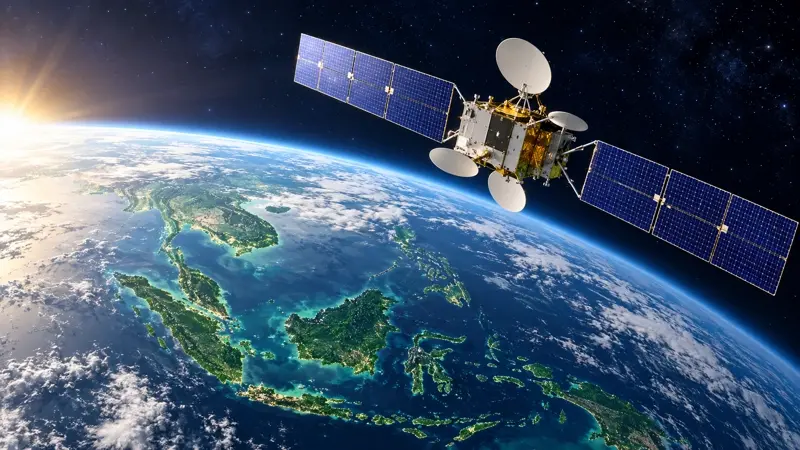
KUALA LUMPUR — MEASAT Satellite Systems Sdn Bhd (MEASAT) has proposed five priorities for Budget 2027 to strengthen Malaysia’s sovereign SpaceTech capabilities, including greater investment in critical infrastructure, local technology development and specialised talent.
MEASAT Chief Operating Officer Yau Chyong Lim said the priorities were aimed at strengthening Malaysia’s control over critical infrastructure and data while supporting national resilience, economic competitiveness and strategic independence.
He said Malaysia’s space sector generated RM6.2 billion in revenue between 2017 and 2024 and is targeted to surpass RM10 billion by 2030.
“With the implementation of Malaysia Space Exploration 2030 (MSE2030) from 2027 to 2030, Budget 2027 can play a pivotal role in translating this ambition into sustainable economic growth, technological advancement and national resilience,” he said.
Yau said MEASAT had established end-to-end sovereign satellite connectivity capabilities to keep critical national communications, infrastructure and data under Malaysian control.
The company’s first priority is to prioritise sovereign space capabilities, including recognising Malaysian-controlled space assets and capabilities as a national investment priority, incorporating sovereignty considerations into procurement for critical communications and national security applications, and strengthening local ownership and participation in national space programmes.
The second priority is to support long-term infrastructure investment in the space industry by establishing investment frameworks aligned with the lengthy development cycles of space infrastructure, encouraging public-private partnerships in multi-orbit platforms and nationally governed data systems, and providing stable policies to support sustained industry investment.
MEASAT also called for the acceleration of integrated SpaceTech applications, including the integration of Geostationary Earth Orbit (GEO), Low Earth Orbit (LEO) and terrestrial networks.
It said the use of Earth Observation, satellite Internet-of-Things, artificial intelligence and analytics should also be expanded for applications such as disaster management, maritime surveillance, precision agriculture, rural healthcare and smart infrastructure.
The fourth priority is to strengthen SpaceTech commercialisation by local companies through support for the development, testing and adoption of locally developed solutions, greater collaboration among industry, start-ups, universities and research institutions, and improved access to regional and international markets for Malaysian companies.
The fifth is to develop specialised research and talent, including stronger industry-academia collaboration in research and development, intellectual property creation and the development of local expertise in engineering, telecommunications, data analysis, remote sensing, artificial intelligence and space regulation.
MEASAT said Malaysia already had a strong foundation comprising sovereign orbital rights and spectrum resources, satellites, ground infrastructure, engineering expertise and regulatory capabilities.
“These priorities will build on existing strengths while supporting the aspiration of MSE2030 and Dasar Angkasa Negara 2030,” it said.
As MEASAT marks 30 years since the launch of MEASAT-1 and MEASAT-2, the company said it remained committed to supporting the Malaysian SpaceTech value chain, covering talent development, research and development, design, manufacturing, launch, operations, support services and commercialisation.
MEASAT said it would continue collaborating with the Government, the Malaysian Space Agency, industry players, universities and research institutions to advance Malaysia’s space agenda beyond 2030.