
KOTA KINABALU — The Sabah Government wants to maximise the economic value of its oil and gas industry by expanding local participation, attracting investment and developing higher-value activities beyond exploration and production.
Chief Minister Datuk Seri Panglima Hajiji Noor said the focus should not be solely on the state’s oil and gas reserves, but also on the economic benefits that could be generated for Sabah and its people.
“The more important question is not merely how much oil and gas resources Sabah possesses, but how much value we can derive from these resources for the benefit of the state and its people,” he said.
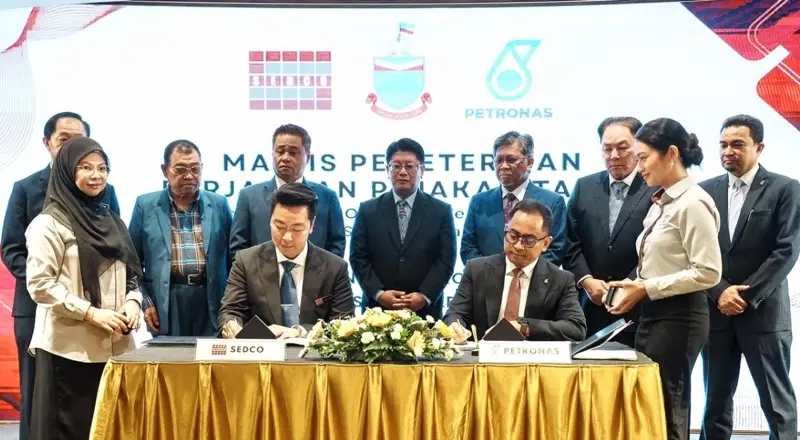
His speech was delivered by Deputy Chief Minister III and State Industrial Development, Entrepreneurship and Transport Minister Datuk Ewon Benedick at the signing ceremony of the land lease agreements for the Sabah Oil and Gas Terminal (SOGT) and Sabah-Sarawak Gas Pipeline (SSGP) projects between the Sabah Economic Development Corporation (SEDCO) and PETRONAS at Hyatt Regency Kinabalu here today.
Hajiji said the oil and gas industry covered an extensive value chain, including infrastructure, support services, midstream and downstream activities, vendor development, technology, skilled manpower and investment.
“Certainly, we want the growth of this industry to generate wider economic spillover benefits for Sabah,” he said.
He said the expansion of exploration activities and discoveries of new resources in recent years pointed to promising prospects for the state’s oil and gas industry.
Hajiji said the SOGT and SSGP facilities should not be viewed solely in terms of their operational functions, but also as strategic infrastructure supporting Sabah’s broader economic development.
Their strategic locations could create opportunities for additional economic and industrial activities in surrounding areas, particularly along the Kimanis-Sipitang corridor, which has the potential to emerge as a major growth area in the state.
He said the infrastructure should be leveraged not only to meet current needs but also to support future investments, industrial expansion and socioeconomic development.
Hajiji also acknowledged PETRONAS’ longstanding contributions, investments and expertise in developing Sabah’s oil and gas industry, describing the national oil company as an important development partner to the state.
He said the state government wanted to expand opportunities for local participation by enabling Sabah-based companies and vendors to move beyond support services and build stronger technical, managerial, technological and financial capabilities.
Local companies, he said, must be equipped to participate in larger-scale and higher-value opportunities across the industry’s value chain, with PETRONAS expected to work alongside the state government to achieve this objective.
He stressed that industrial growth must also be accompanied by human capital development to ensure Sabahans had access to the skills, experience and exposure needed to pursue careers in the oil and gas sector, particularly in technical and professional fields.
Hajiji said SEDCO should continue evolving beyond its traditional role as an asset owner and manager to become an investment facilitator and strategic industry partner.
This would require a more proactive approach to identifying assets, investment opportunities and potential collaborations with industry players, including those involving land, infrastructure and commercial development.
Such initiatives, he said, should generate mutual benefits while delivering reasonable returns to the state.
He said the land lease agreements between SEDCO and PETRONAS demonstrated how state land assets could be managed more systematically, providing certainty for users while safeguarding the state’s commercial interests.
Hajiji expressed hope that the collaboration would develop beyond a transactional relationship into a broader strategic partnership that created mutual value and ensured Sabah’s resources and assets generated tangible, long-term economic benefits.