
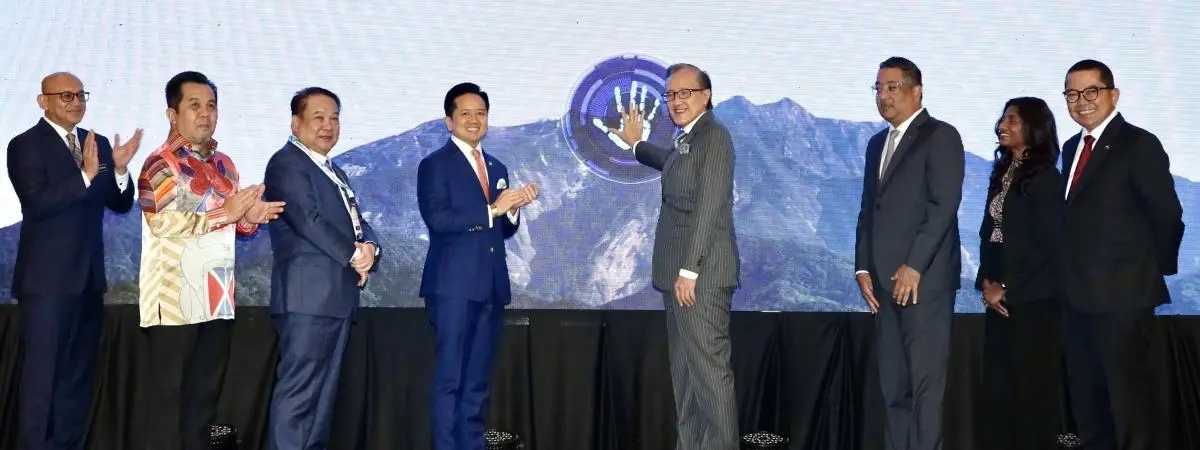
KOTA KINABALU — Sabah will not allow unvetted carbon market projects to be rushed to market or traded speculatively, as the state seeks to protect its reputation and credibility in the emerging carbon economy.
Chief Minister Datuk Seri Panglima Hajiji Noor said poorly designed projects, overstated climate claims, undervalued resources and the exclusion of native communities could undermine investor confidence in Sabah’s carbon credits.
“We will protect Sabah’s reputation and brand through strong regulatory discipline.
“It is therefore in Sabah’s commercial interest to uphold the highest standards of environmental, social, financial and governance integrity. Buyers will demand full transparency,” he said when opening the Sabah Carbon Market Forum: Unlocking Carbon Market Opportunities for Sabah at the Hilton Hotel here today.
Deputy Chief Minister II and State Finance Minister Datuk Seri Panglima Masidi Manjun delivered Hajiji’s speech.
Hajiji said the Sabah Climate Change and Carbon Governance Enactment 2025 legally recognises the state government’s ownership of carbon rights and establishes clear rules for carbon-related activities, including project approvals and carbon credit trading.
He said the Sabah Climate Change Action Council (SCCAC) would oversee the state’s climate policy, prepare the state carbon budget for ministerial approval and gazettement, and coordinate efforts between state and federal agencies.
“The Sabah Climate Registry and Inventory Centre will provide technical and operational support to the SCCAC.
“Together, this framework is intended to offer investors a transparent and coordinated regulatory gateway for project approvals and the registration of carbon rights,” he said.
Hajiji said Sabah is home to Malaysia’s first nature-based verified carbon credit initiative through the Kuamut Rainforest Conservation Project, which covers about 83,381 hectares of lowland and hill forests.
The project is expected to deliver emission reductions of about 800,000 tonnes of carbon dioxide (CO2) and has been rated best-in-class by global carbon credit ratings agency BeZero Carbon.
He said the state government was also developing a diversified portfolio of carbon assets across key economic sectors, including the blue economy, agriculture, renewable energy and green technology, as well as carbon capture and storage (CCS).
Under the blue economy, Sabah has more than 340,000 hectares of mangroves, representing the largest continuous mangrove area in Malaysia.
“We have strong potential to become a regional leader in the blue economy through marine biotechnology, sustainable aquaculture and marine ecosystem-based tourism,” he said.
In agriculture, Hajiji said Sabah’s oil palm industry, which covers nearly 1.5 million hectares, offered significant opportunities for methane capture and other climate mitigation initiatives involving agricultural waste.
For renewable energy and green technology, he said the state, guided by the Sabah Energy Roadmap and Master Plan 2040, would continue expanding solar, hydropower, biomass and biogas to provide reliable, accessible and affordable energy.
“Sabah aims to increase the share of renewable electricity by 2030 through solar, hydropower and biomass projects,” he said.
On CCS, Hajiji said Sabah’s offshore geological basins and maritime frontier offered long-term potential for geological carbon storage, positioning the state as a nationally significant industrial storage hub serving the region.
He said almost 30 per cent of Sabah’s landmass had been designated as Totally Protected Areas (TPAs), contributing to Malaysia’s biodiversity commitments and the 2030 global conservation target under the Kunming-Montreal Global Biodiversity Framework.
“Sabah is also Malaysia’s primary net carbon sink, or carbon-negative state, based on greenhouse gas inventory data. Our extensive forest cover strengthens Malaysia’s overall carbon absorption capacity of roughly 36 per cent,” he said.
Hajiji said Sabah’s inclusive forest management approach, developed in partnership with local communities, sought to balance environmental conservation with the socio-economic wellbeing of the people.
“Sabah’s identity and future are deeply rooted in our natural heritage.
“Under our Sabah Maju Jaya (SMJ) development roadmap, we are moving decisively towards conservation with value, turning the protection of our natural assets into responsible economic opportunities,” he said.
He said the focus now was on implementation, including developing credible projects, creating market demand, securing financing and ensuring that conservation delivered lasting value.
Hajiji also called on financial institutions, including Bursa Malaysia, commercial leaders and investors to develop or co-develop practical financing frameworks to bridge the capital gap for credible carbon projects and support the 2030 climate targets under the Paris Agreement.
“We invite you to partner with us, to invest in Sabah, establish your technical operations here and unlock the true value of our natural capital,” he said.
Also present were Federal Natural Resources and Environmental Sustainability Minister Datuk Seri Arthur Joseph Kurup, Sabah Agriculture and Fisheries and Food Industry Minister Datuk Jamawi Jaafar and Sabah Rural Development Minister Datuk Rubin Balang.