
I have been thinking about this matter for quite some time, and a recent trip from Labuan to Kota Kinabalu reminded me that it is time to put my thoughts into an Editor’s Note.
The subject is something many road users in Sabah may have experienced, particularly those travelling at night: the darkness along some of the state’s roads.
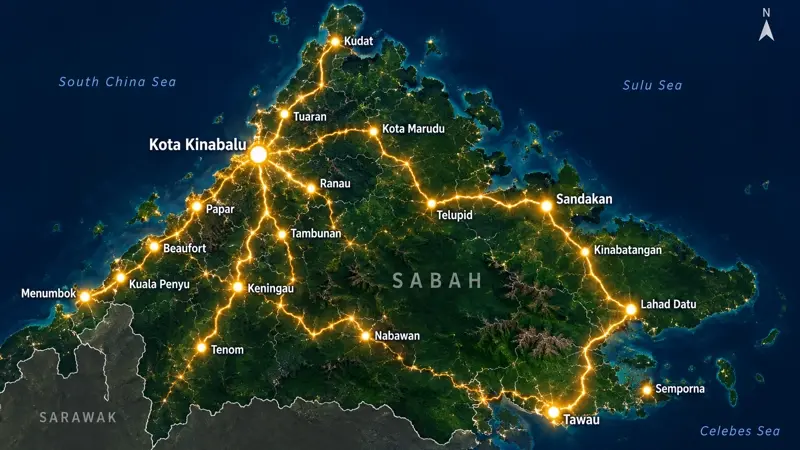
We arrived at Menumbok on a roll-on/roll-off (RoRo) ferry shortly before 10 pm after departing Labuan at about 8.30 pm. As soon as we disembarked and began our journey towards Kota Kinabalu, the story began.
Although some stretches of the road are illuminated by streetlights, much of the journey remains in darkness. Some sections, particularly along the road from the “Turtle Roundabout” in Kuala Penyu towards Beaufort, can be particularly challenging at night.
Drivers have to remain especially alert because a road that appears to continue straight ahead may suddenly curve to the left or right. In some places, the absence of adequate reflective road markers or other visible guidance makes it more difficult to identify the road alignment, particularly at night.
And this is only one part of the challenge faced by those travelling after dark—not only between Menumbok and Kota Kinabalu, but also on roads in other parts of Sabah.
It is already 2026. Yet, many stretches of road connecting Kota Kinabalu with major towns such as Sandakan, Tawau and Keningau remain poorly illuminated at night.
This is an unfortunate situation, particularly when technology that could help address the problem is already available.
Solar-powered streetlights, including relatively low-cost systems, could provide a practical option for areas where conventional street lighting may be difficult or costly to install. I understand that some areas in Sabah have already adopted solar-powered streetlights, and this is a positive development.
Perhaps the initiative could be expanded, particularly along major routes connecting Kota Kinabalu with the state’s main towns.
The initial phase could focus on key roads leading from Kota Kinabalu to major towns on the east coast and interior of Sabah, before being extended to other routes where the need is identified.
Some may argue that business and economic activity continue regardless of whether the roads are illuminated.
Yes, trade and commerce continue. People continue to travel, goods continue to move and businesses continue to operate.
But that does not mean we should accept darkness on our roads as the norm.
Better lighting would not only make night-time driving more comfortable; it could also improve visibility and provide road users with better awareness of curves, junctions, obstacles and other potential hazards.
Why do we need better lighting?
Road users travelling at night in Sabah already face another significant challenge: road conditions.
In some places, drivers have to contend with uneven surfaces, potholes, road damage or inadequate markings while relying almost entirely on their vehicle headlights.
When poor road conditions are combined with inadequate lighting, the risks become greater.
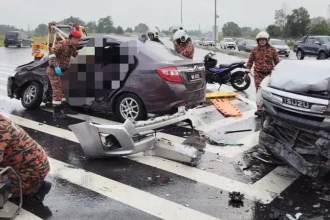
This raises an important question: how many accidents or near-misses could be prevented if road users had better visibility and clearer guidance at night?
I am not suggesting that street lighting alone will solve Sabah’s road safety challenges. Road maintenance, proper markings, reflectors, signage and enforcement are equally important.
But lighting is one practical part of the solution.
Sabah is a large state, and providing conventional street lighting along every road may not be immediately practical. That is precisely why solar-powered lighting deserves serious consideration.
The objective is simple: to fight the darkness on Sabah’s roads.
For those of us who regularly travel between Labuan and Sabah, or across Sabah itself, this is not merely a matter of convenience. It is about making journeys safer for everyone—families, workers, commercial vehicles, public transport users and visitors travelling after dark.
The roads connecting Sabah’s towns are important arteries for the state’s economy and its people.
They should not disappear into darkness when the sun goes down.
Adrian Nandu
Editor-in-Chief