
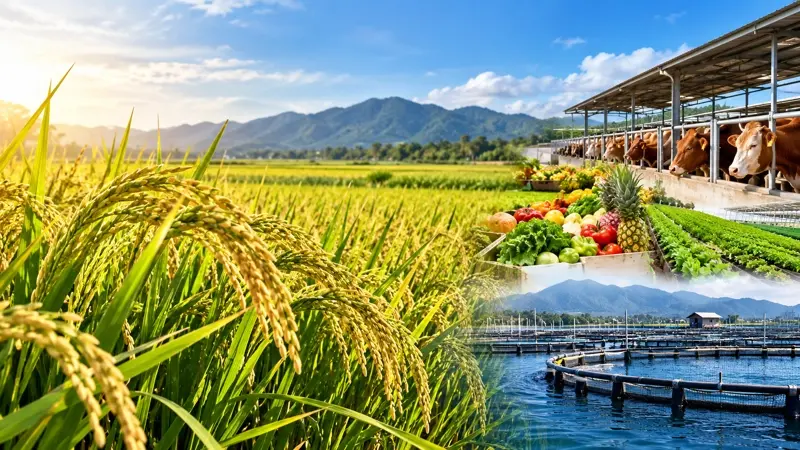
PUTRAJAYA — The Ministry of Agriculture and Food Security (KPKM) has proposed that state governments gazette padi granary areas to ensure the sustainability of rice cultivation and strengthen the country’s food security.
Agriculture and Food Security Minister Datuk Seri Mohamad Sabu chaired the second 2026 meeting with state agriculture executive councillors (Excos) on Oct 1, which was attended by agriculture Excos from nine states, representatives of the State Economic Planning Units (UPEN), Ministry of Finance (MOF) and Ministry of Economy, as well as senior KPKM officials and heads of departments and agencies.
The proposal takes into account the decline in padi cultivation areas, which contributed to a drop in the country’s rice self-sufficiency ratio (SSR) from 68.0 per cent in 2018 to 54.3 per cent in 2025.
This has increased Malaysia’s dependence on imported rice, with imports estimated at 1.416 million tonnes worth RM2.953 billion in 2025.
The meeting also took note of the National Audit Report’s recommendation to gazette padi granary areas to preserve land allocated for rice cultivation.
It also discussed state government participation in Malaysia Fest in Singapore, which has served as a platform to promote Malaysian agri-food products since 2006 through the Malaysia Fruits, Food Fiesta (M3F) programme.
Visitor numbers at Malaysia Fest increased from 75,000 in 2017 to 179,400 in 2025, while sales rose from RM6.59 million to RM15.8 million, providing greater opportunities for local entrepreneurs to penetrate the Singapore market.
The meeting also discussed zoning food source areas under Structure Plans and Local Plans in line with the National Land Use Planning Master Plan (KAGUMN), the immediate gazettement of 24 state agri-food areas under the Permanent Food Production Park (TKPM), Permanent Ruminant Production Park (TKPR) and Aquaculture Industry Zones (ZIA), as well as the implementation of the Livestock Farm Regularisation Scheme (Interim Five-Year).
It also discussed the Food Area Protection Mechanism in Sabah and Sarawak to increase the SSR of strategic commodities, boost domestic production and strengthen national food security and resilience.
The meeting was also briefed on the National Agri-Food Empowerment Programme (PPAN), a continuation of the Land Optimisation Programme in collaboration with state governments under the 2024 and 2025 Budgets.
Approved under the 13th Malaysia Plan (RMK-13), PPAN has a project cost of RM1 billion for 2026 to 2030. In 2026, 782 applications worth RM2.09 billion were received, with 347 projects involving RM349.15 million in allocations approved.
The meeting also took note of the outcome assessment of the 2024 Land Optimisation Programme, which involved 97 projects, 19,447 participants, approximately 40,000 hectares of land and RM149.59 million in allocations.
On industry regulation, the meeting was briefed on the drafting of the Fertiliser Bill to establish a more structured, transparent and effective regulatory framework for the fertiliser industry, particularly in ensuring fertiliser quality, distribution and price stability while protecting farmers’ interests.
The need to strengthen regulation has become increasingly significant given that the country’s fertiliser industry was estimated to be worth RM4.4 billion in 2020.
The meeting also took note of the findings of the KPKM Agricultural TVET Graduate Profile and Distribution Study for 2018 to 2024, conducted in collaboration with the PNB Research Institute, involving 6,829 complete graduate responses.
The ministry said the meeting served as an important platform to strengthen strategic cooperation between the Federal and state governments in ensuring food security and developing a more structured and sustainable agri-food sector.