

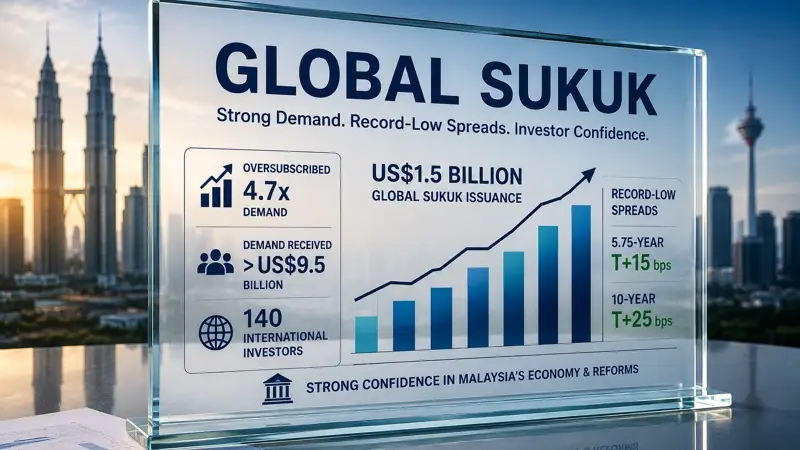
KUALA LUMPUR — Malaysia’s US$1.5 billion Global Sukuk issuance was oversubscribed 4.7 times, attracting demand exceeding US$9.5 billion and enabling the government to price the offering at the lowest spreads ever achieved for a Malaysian global sukuk issuance.
The issuance comprises a US$850 million 5.75-year tranche and a US$650 million 10-year tranche. Strong investor demand allowed the government to tighten pricing by 30 basis points from the Initial Price Guidance (IPG) to US Treasury plus 15 basis points for the 5.75-year tranche and US Treasury plus 25 basis points for the 10-year tranche.
The Ministry of Finance said the successful issuance underscores Malaysia’s standing in the international financial market by establishing a new benchmark that will serve as an important pricing reference for future global issuances by government-linked entities and the private sector. It added that the robust demand reflects continued investor confidence in Malaysia’s fiscal and economic reform agenda despite a challenging global environment.
The sukuk is asset-backed by service rights in Malaysia’s urban public rail transport network and is structured under the Manafae concept in accordance with the guidelines of the Accounting and Auditing Organization for Islamic Financial Institutions (AAOIFI), reinforcing Malaysia’s position as a global leader in Islamic finance and the sukuk market.
Second Finance Minister Datuk Seri Amir Hamzah Azizan said Malaysia’s economic policies, guided by the MADANI Economy framework, have strengthened public finances, supported sustainable economic growth and laid a solid foundation for long-term resilience.
“The strong oversubscription and record-low spreads reflect sustained confidence among international investors in Malaysia’s economic prospects and sound development policies. This demonstrates that our reform agenda, prudent debt management strategy and commitment to sustainable growth continue to attract high-quality investors despite global uncertainties,” he said.
The ministry said the favourable response comes three years after the launch of the MADANI Economy framework on July 27, 2023. During the period, Malaysia’s fiscal deficit narrowed from 6.4 per cent of gross domestic product (GDP) in 2021 to 3.7 per cent in 2025, while government borrowings declined to nine per cent of GDP from 13.6 per cent over the same period, reflecting continued fiscal discipline under the Public Finance and Fiscal Responsibility Act 2023.
Malaysia’s economy expanded by 5.2 per cent in both 2024 and 2025, supported by resilient domestic demand and strong private investment. Approved investments reached RM431.1 billion in 2025, while total trade exceeded RM3 trillion for the first time at RM3.06 trillion. Growth momentum continued into 2026, with the economy expanding 5.4 per cent in the first quarter, while advance estimates indicated second-quarter growth of 5.8 per cent, surpassing earlier projections.
Both tranches were assigned ratings of A3 by Moody’s Investors Service and A− by S&P Global Ratings, in line with Malaysia’s sovereign credit ratings and stable outlook. The 5.75-year tranche was priced at a profit rate of 4.612 per cent per annum, while the 10-year tranche carries a profit rate of 4.949 per cent per annum.
The investor engagement programme attracted 140 international investors, including sovereign wealth funds, central banks, government institutions, asset managers, financial institutions, insurance companies and pension funds. Asian investors accounted for 76 per cent of the 5.75-year tranche allocation and 63 per cent of the 10-year tranche, followed by investors from Europe, the Middle East and Africa (EMEA) and the United States.
The issuance was conducted in accordance with Regulation S and Rule 144A of the United States Securities Act of 1933 and will be listed on the Hong Kong Stock Exchange, Labuan International Financial Exchange and Bursa Malaysia under the Exempt Regime. Proceeds will be used for Shariah-compliant general government purposes, including financing development expenditure and/or refinancing existing obligations.
CIMB, HSBC, J.P. Morgan and Standard Chartered Bank acted as Joint Lead Managers and Joint Bookrunners for the issuance, while the sukuk’s Shariah structure received approvals from the respective Shariah supervisory committees of the participating financial institutions.