
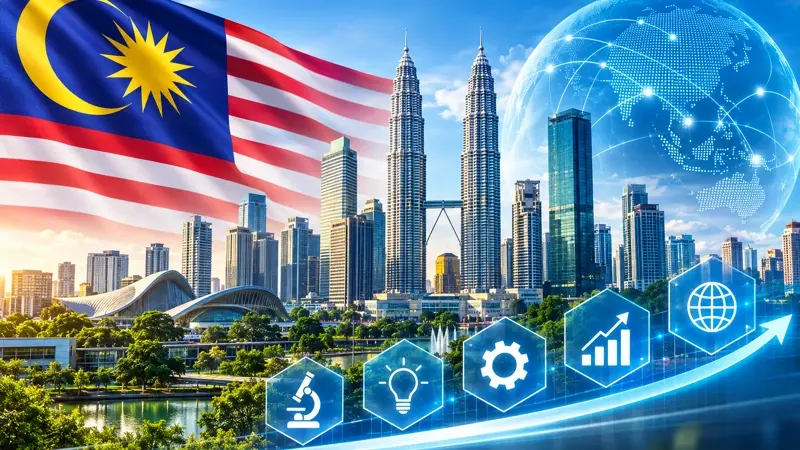
PUTRAJAYA — Malaysia maintained its 34th position among 139 economies in the Global Innovation Index (GII) 2026, with its overall score improving to 41.8 from 40.6 in 2025, according to the Ministry of Science, Technology and Innovation (MOSTI).
Published by the World Intellectual Property Organization (WIPO), the index ranked Malaysia second in Southeast Asia after Singapore and second among 35 upper-middle-income economies after China.
Science, Technology and Innovation Minister Datuk Chang Lih Kang said the higher score reflected progress in the country’s innovation capabilities, despite Malaysia retaining its previous ranking.
He said MOSTI’s priority was to translate the country’s strengths in research, talent and technology into more locally developed intellectual property, commercialised research outcomes and globally competitive technology companies.
Four of the index’s seven pillars improved compared with 2025, with Malaysia ranking 27th in Institutions, 51st in Infrastructure, 28th in Business Sophistication and 32nd in Knowledge and Technology Outputs.
Market Sophistication remained Malaysia’s strongest pillar, placing 19th globally.
Malaysia also ranked first worldwide in high-tech exports and imports, third in start-up and scale-up financing as well as creative goods exports, eighth in science and engineering graduates, and ninth in policy stability for doing business.
The country’s innovation ecosystem was further supported by two internationally ranked innovation clusters. The Singapore-Malaysia cross-border cluster, centred on Johor Bahru, retained 16th place, while Kuala Lumpur ranked 90th among the world’s Top 100 Innovation Clusters in 2026.
In line with this year’s GII theme, Powering Entrepreneurs at the Frontier of Science, the number of Malaysian science-based start-ups grew by 116.7 per cent between 2020 and 2025.
MOSTI said it would continue working with government agencies, higher education institutions, research organisations, industry players and funding providers to strengthen the conversion of research, talent, technology and financing into local intellectual property, commercialisation, high-growth companies, skilled employment and higher national productivity.
These efforts will be supported by coordinated indicator ownership, annual targets and measurable interventions through 2030.